The Land of Children
Thus Spoke ZarathustraThe Land of Children is Zarathustra’s image of a future that does not yet exist but can give present life a direction. It lies in an “undiscovered land in the furthest sea,” and its distance matters: the future cannot be inherited as a finished home or reached by following an established route. It must be sought, loved, and made. The image therefore gathers several of the book’s concerns into one horizon: estrangement from inherited homes, the creation of new values, and responsibility toward those who come after.
A Future Beyond Inherited Homes
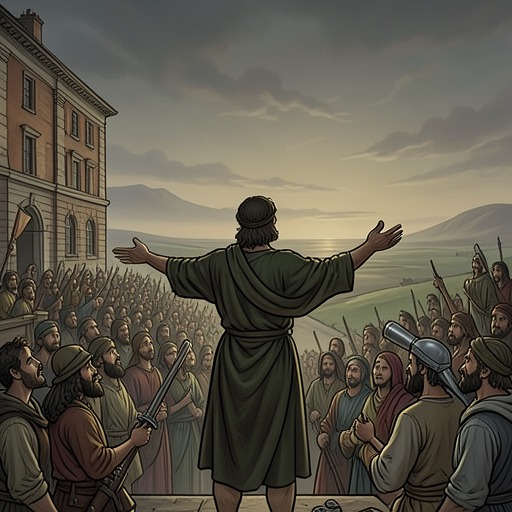
Zarathustra describes himself as unsettled in every city, departing from every gate and finding no home among the people of the present. Those people, once drawn to him, have become strange and a mockery; he says he has been driven from fatherlands and motherlands. Against that experience of displacement, the Land of Children is not a return to a lost homeland. It is a destination not yet discovered, sought across the sea rather than recovered by looking backward.
The change in direction is explicit in Zarathustra’s injunction to nobility: “your nobility shall not gaze backward, but outward!” He calls his hearers fugitives from fatherlands and fore-fatherlands, then commands them to love the children’s land and make that love their new nobility. The contrast is not simply between past and future. It is between a status grounded in inherited origins and a nobility measured by commitment to what remains to be created. The future land is thus a proposed orientation, not a description of an existing society.
Making Amends to the Future
Zarathustra gives this outward turn an ethical and temporal force. He says that he will make amends to his children for having been the child of his fathers, and to all the future for the present. The formulation connects generations without treating the past as something that can simply be erased: the speaker acknowledges inheritance while seeking to answer for what the present hands onward. His call to seek the children’s land becomes a way of taking responsibility for a future that the present cannot yet see.
The same demand appears as a new law-table. Zarathustra tells his hearers to make amends to their children for being the children of their fathers and declares that through this they will redeem all that is past. The command gives the future-facing ideal a practical shape: inherited life becomes material for a different future, rather than a final authority that must be repeated. The passage does not specify institutions or a political program for the land. Its emphasis is on the direction of loyalty and the work of revaluation that such loyalty requires.
Children, Companions, and Creation
The image also belongs to Zarathustra’s account of creation. Looking back on his work, he says that the creator once sought companions and children of his hope, only to discover that he could not find them unless he first created them himself. The hoped-for community is not waiting intact somewhere in the distance. Its absence becomes a reason to create, not a reason to abandon the hope.
Zarathustra presents himself as being in the midst of this work: he goes to his children and turns away from them, because for their sake he must perfect himself. The movement is deliberately double. His relation to what he creates involves both approach and withdrawal, while self-perfection is linked to the future rather than presented as an isolated private achievement. He adds that one loves from the very heart one’s child and one’s work, and that great self-love is a sign of pregnancy. In this image, creative self-regard signals a capacity to bring something new into being; the children’s future is bound to the creator’s unfinished work.
Values and the Open Road
The Land of Children belongs to a book in which values are made rather than simply received. In “Of the Thousand and One Goals,” Zarathustra has seen many lands and peoples and found that none could live without evaluating, while each people must not evaluate as its neighbour evaluates if it wishes to maintain itself. That account gives the future land a broader context: a people’s values are consequential creations, not neutral rules detached from life. The children’s land names a future toward which a new act of evaluation can be directed.
Elsewhere, the book’s interpretation of Zarathustra presents truth as something willed and created: life receives meaning through an act of determination, and the will to truth is described as walking with the Will to power. This is not a geographical explanation of the children’s land, but it clarifies the logic of its hope. The future is not a truth already waiting to be discovered and obeyed; its meaning depends on the work of those who seek it. Zarathustra’s answer to people asking for a way is correspondingly resistant to a fixed route: “For the way – does not exist!” The Land of Children remains a horizon rather than a completed destination, and its force lies in making creation, rather than inheritance, the measure of fidelity to the future.